• Skip to primary navigation
  • Skip to main content
  • Skip to footer
  • FCD Career Class
  • Online Learning
    • Info about Online Seminars
    • 12 Month Calendar
    • Anxiety and Career Development: Theory, Practice, and Resources
    • Building Your Coaching Business
    • Career Readiness for Justice-Involved Citizens: Factors, methods, and insights
    • Career Advising Using Happenstance
    • Career Trends of the Future: So Much More than AI and Robots
    • EQ at Work: Emotional Intelligence for Career Practitioners
    • Finding Purpose: Working with Clients To Find Meaningful Work
    • LinkedIn: Advancing Your Skills
    • Transition Theory in Career Advising
    • Retirement Coaching: Unlocking New Opportunities for Your Clients
    • Social Media Strategies for Career Practitioners
    • Understanding Holland Interest Theory and Practical Applications
  • Workshops & Training
Peak Careers

Peak Careers

Professional Development for Career Practitioners

  • About
    • About Peak-Careers
    • Meet The Team
    • Peak-Careers Advisory Board
    • Privacy Policy
  • Shop
    • Field Guide BOOK
    • The Adventure of Finding Me in New Zealand
    • Career Poster
    • Webinars
      • WEBINAR: Mindfulness, Positive Psychology & Neuroscience to Help Yourself & Your Students/Clients
      • How To Successfully Build Your LinkedIn Network and Beyond
      • How To Successfully Work With Recruiters
      • WEBINAR: Creating a Value-Added Resume
      • Develop Confidence in Clients
      • Linkedin Train-the-Trainer
      • Develop Value-Added Statements
  • Resources
    • Career blogs
    • Book Reviews
    • Interviews
      • INTERVIEW: Choosing 3 Words to Guide You
      • INTERVIEW: With a Few Book Lovers
      • INTERVIEW: Brand Yourself On LinkedIn
      • INTERVIEW: Staffing & Recruiting Agencies
      • INTERVIEW: Would You Benefit from Hiring a Business Coach?
      • INTERVIEW – Creating the Conversation Using Card Sorts
      • INTERVIEW: TED Talks for Career Practitioners
      • INTERVIEW: What is Mindfulness and Why Should Career Practitioners Care?
      • INTERVIEW: My Three Words to Guide Me in 2019
      • INTERVIEW: Reading Books for Professional Development
  • Contact

Search Results for: tech free retreat

Slow Down to Be Better

November 29, 2021 by Jim Peacock Leave a Comment

My biggest mistakes have come when I am in a hurry. As an ENFP (Myers-My biggest mistakes have come when I am in a hurry. As an ENFP (Myers-Briggs definition is a golden retriever  in a room with 5 tennis balls) I have had a lifetime of “open mouth, insert foot” episodes. What I have learned is that I need to slow down.  It seems to me that the holidays are a great time for us all to remember to slow down and here are my tips to help you get started.

Image by Katrin B. from Pixabay

There is a part of me that always feels like I can do more. When I was a high school counselor I felt that seeing more students was the way to do my job. But eventually I figured out that I had to block out an hour of my calendar for no students. By slowing down the flow of students, I was able to take better control of my day. 

Slow Down Tip #1

Look at your day and make sure you are taking time to slow down and take care of yourself so that you can serve others more effectively.
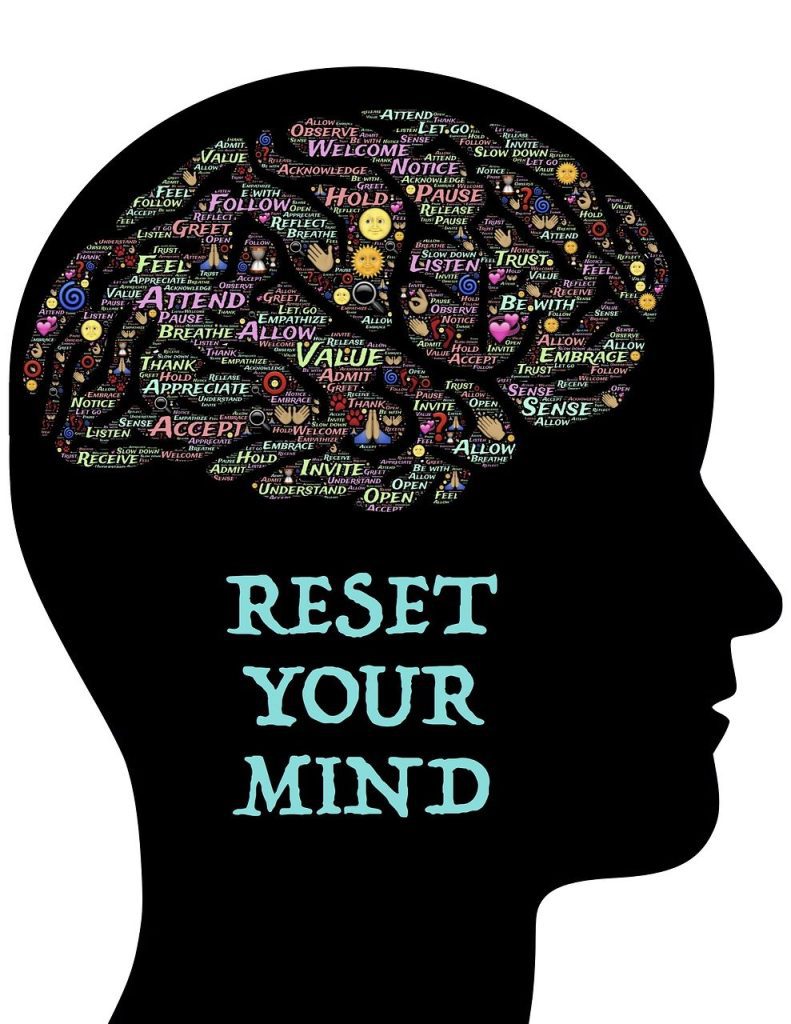
Slowing down is more than just time management, it is about self-care. I’ve written about and interviewed people on mindfulness many times, so I won’t spend a lot of time on it today. Just know that 10-15 minute breaks can refuel your mind and body allowing you to  provide better service to everyone you meet.

Slow Down Tip #2

Set a timer if you have to, or block out some time in your day to stop and take 4 deep breaths, or listen to a guided mindfulness app like Calm or Insight Timer. Need some wonderful calming music? Check out this YouTube channel.  https://www.youtube.com/watch?v=yfYjEkaN-1s

(Image by John Hain from Pixabay)

I try to take a daylong tech-free retreat once a month. I know this is not for everyone, but I challenge you to embrace the idea that turning off your social media feed and phone for even a few hours can be quite freeing. Especially when you realize you didn’t really miss anything too important.

Slow Down Tip #3

Look at your calendar and start by blocking off 2-4 hours of time to turn off social media and your phone, or better yet all your technology. Use this time to read, reflect, plan, meditate, or whatever you want. 

With the holiday season upon us, this is a great time to remember to slow down and be calm with yourself. Trust me, you deserve it and will be a better person for it.

Need more proof about slowing down?

Check out these two TedTalks.

What else can you do to slow down?

Note: Featured Image of Giant tortoise by Alexas_Fotos / 21623 images


Jim Peacock is the Principal at Peak-Careers Consulting and writes a weekly email for career practitioners. Peak-Careers offers discussion-based online seminars for career practitioners focused on meeting continuing education needs for CCSP, GCDF and BCC certified professionals as well as workshops for career practitioners and individual career coaching.

He is the author of A Field Guide for Career Practitioners: Helping Your Clients Create Their Next Move and The Adventure of Finding Me in New Zealand. He is also the recipient of the 2020 Kenneth C. Hoyt Award from the National Career Development Association and the Mid-Atlantic Career Counseling Association’s Professional Contribution’s Award in 2020.

Sign up here to receive my  TOP 10 TIPS WHEN WORKING WITH AN UNDECIDED PERSON.  You will also receive the career practitioner’s weekly email on a variety of career topics, industry news, interesting events, and more. 
Filed Under: Career Tagged With: mindfulness, slow down, slowing down

Thinking about starting a career coaching private practice?

August 9, 2021 by Jim Peacock 2 Comments

I started part-time with Peak-Careers while I was working as the Director of Advising & Career at a community college and never thought I’d go full-time with it. After 10 years my consulting business kept growing and growing and I finally took the leap to private practice full-time with Peak-Careers Consulting in 2012.

Here are a few tips I have learned over the years that I wished I had known when I was starting out.

private practice
Image by Gerd Altmann from Pixabay
  1. Begin now.
    Don’t worry about what you have not done or what you “should” do. Start now and write down what you want to do and how you want to do it. What is your “super-power” that makes you unique? By writing it down it helps you take it out of your head and make it more real. (link to journaling)
  2. Take the time.
    The most powerful gift I give myself is my monthly, or bi-monthly, tech-free day-long retreat. You need to find the time to sort out the many details of what you want to do, how you will do it, when you will do it, and who needs to help. Find at least a half of a day where you can leave all the “to do’s” aside and really focus on what your private practice could be.
  3. Set goals.
    Just like you do with your clients or students, writing down goals and creating concrete, measurable steps that need to be done is important for yourself as well. Give yourself deadlines on when things need to be done so that you see progress.
    And then, share them with someone who can keep you accountable.
  4. Seek advice.
    Starting your own business has a lot of moving parts to it. How do you set yourself up? How do you handle collecting money? What legal considerations do you have? How do you write a business plan? How do you market?
    Talk to other people who have a private practice – there are lots of social media groups out there.
    Consider hiring a business coach.
    Definitely check out the Small Business Administration free support near you. Your independence may be important to you, but don’t do this alone.
  5. Trust Your Instincts.
    Make the best decisions based upon facts, research, and advice but trust your instincts too. Know when to move forward and when to change directions by listening to the voice…that gut feeling…your guardian angel who is watching over you. 
  6. Take the time to evaluate.
    Yeah, I know #2 is “take the time” as well but after you get started in your private practice, take the time to evaluate what is working, what didn’t work, and why, what other opportunities might exist. Even if you are busy juggling a full-time job and your side-gig, find the time to think about your business. My regular tech-free retreats are great at allowing me the space to reflect on my business from the 10,000-foot view.
  7. **Added 7 & 8 after original went out because my good friend Scott Woodard pointed out these two important thoughts.

    One I would add is to remember that it’s a business. To me, the term “private practice” doesn’t carry enough “heft,” it’s almost like a hobby rather than a business. Scott.

    Having come from higher education and K-12 education…I was clueless on running a business! This is such a great point that Scott makes. It really is a business and it really was a ‘mindset’ change for me to think like a business.
  8. The other thing I’ve learned is that I tend to spend a LOT more time in my business (admin, marketing, etc.) than on my business (coaching, consulting). Scott.

    I was shocked at how much time I spent on the business side compared to the time I actually provided career coaching. If I wanted to do more career coaching, I should have stayed at the community college where I would see 5+ students every day and more when I taught the career decision making class.

I wish you the best in your adventure of private practice.

I know I will never work for someone again 40-hours per week. I love the independence and creativity of owning my own business.

If you’d like more assistance (see #4 above)  you may want to check out the 5-week, discussion-based online seminar Mark Danaher and I are offering in October – November. Building Your Coaching Business.


Jim Peacock is the Principal at Peak-Careers Consulting and writes a weekly email for career practitioners. Peak-Careers offers discussion-based online seminars for career practitioners focused on meeting continuing education needs for CCSP, GCDF and BCC certified professionals as well as workshops for career practitioners and individual career coaching.

He is the author of A Field Guide for Career Practitioners: Helping Your Clients Create Their Next Move and The Adventure of Finding Me in New Zealand. He is also the recipient of the 2020 Kenneth C. Hoyt Award from the National Career Development Association and the Mid-Atlantic Career Counseling Association’s Professional Contribution’s Award in 2020.

Sign up here to receive my  TOP 10 TIPS WHEN WORKING WITH AN UNDECIDED PERSON.  You will also receive the career practitioner’s weekly email on a variety of career topics, industry news, interesting events, and more. 
Peak-Careers logo

Filed Under: Career Tagged With: career coaching, private practice

Interview: Visioning Your Future

July 19, 2021 by Jim Peacock Leave a Comment

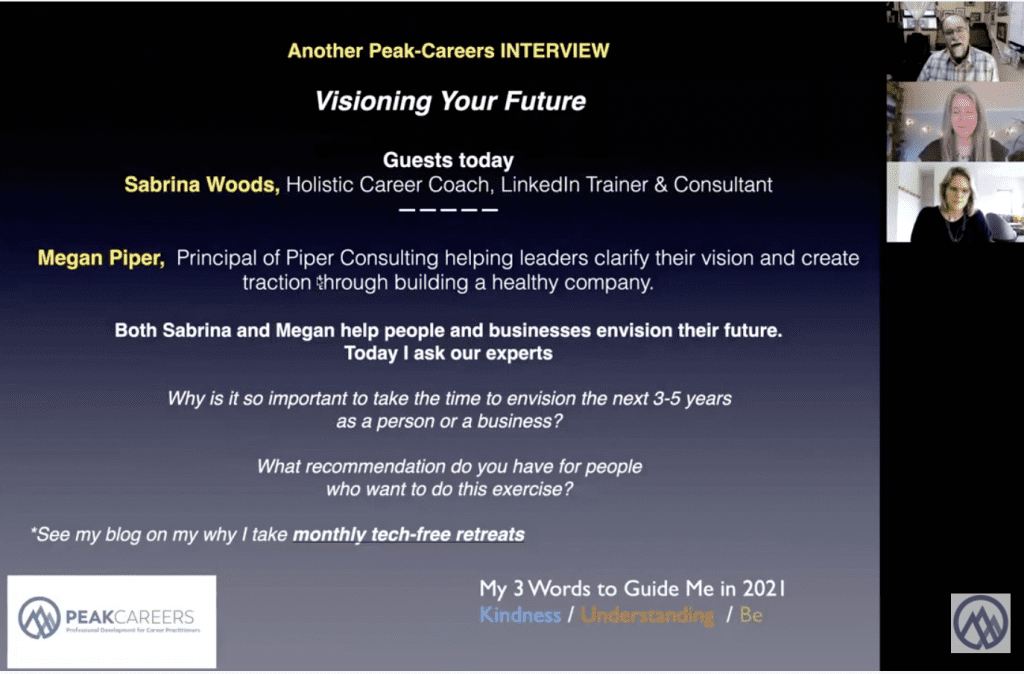
Today I ask our experts:
Why is it so important to take the time to envision the next 3-5 years
as a person or a business?

What recommendations do you have for people who want to do this exercise?

My guests today are Sabrina Woods, Holistic Career Coach, LinkedIn Trainer & Consultant and Megan Piper,  Principal of Piper Consulting helping leaders clarify their vision and create traction through building a healthy company. Both Sabrina and Megan help people and businesses envision their future. 

I attended Sabrina Woods’ annual retreat “Going Beyond New Year’s Resolutions: A Retreat to Reflect on What Matters this past January and I also had the pleasure of attending Megan’s workshop she did for the Maine Association of Training & Development this spring. Both were enlightening and helped me look forward in my personal and work like.

*See my blog on my why I take monthly tech-free retreats

Visioning Your Future

BIO’s

Sabrina Woods is a Holistic Career Coach, LinkedIn Trainer & Consultant. She has 20 years of experience in the career services field including work at Harvard and Northeastern University. She is also the president of the Career Counselors Consortium professional association based out of Boston.  For more info: www.sabrina-woods.com or www.linkedin.com/in/sabrinawoods.

Megan Piper is an Entrepreneurial Operating System Implementer helping leaders clarify their vision and create traction through building a healthy company. She instills purpose, accountability, and discipline, and provides tools to measure progress against meaningful metrics. Megan is uniquely qualified to advise organizations with years of executive experience across diverse environments, from IT to e-commerce, healthcare to non-profits. 
https://piperconsultingco.com/ https://www.linkedin.com/in/meganpiper/


Jim Peacock is the Principal at Peak-Careers Consulting and writes a weekly email for career practitioners. Peak-Careers offers discussion-based online seminars for career practitioners focused on meeting continuing education needs for CCSP, GCDF and BCC certified professionals as well as workshops for career practitioners and individual career coaching.

He is the author of A Field Guide for Career Practitioners: Helping Your Clients Create Their Next Move and The Adventure of Finding Me in New Zealand. He is also the recipient of the 2020 Kenneth C. Hoyt Award from the National Career Development Association and the Mid-Atlantic Career Counseling Association’s Professional Contribution’s Award in 2020.

Sign up here to receive my  TOP 10 TIPS WHEN WORKING WITH AN UNDECIDED PERSON.  You will also receive the career practitioner’s weekly email on a variety of career topics, industry news, interesting events, and more. 
Peak-Careers logo

Note: Featured image Image by Gerd Altmann from Pixabay

Filed Under: Interviews Tagged With: goals, visioning, visioning the future

Why I Write: And Why You Might Want To

June 7, 2021 by Jim Peacock 2 Comments

Recently, I went on another tech-free retreat for the day which I try to do monthly. It is a time to think, read, plan, do walking meditation, and to write. I mind-mapped out five new blogs (one of them is this one). Last week I was working with a student in my Facilitating Career Development (FCD) class and we interviewed each other for one activity and I had a very revealing “aha” moment. She asked me “there are times in our lives when we feel particularly energized and positive. What was yours?”

What immediately came to mind is writing. In the summer of 2018, I started writing my book, A Field Guide for Career Practitioners, and I devoted the first hour of each day (Monday-Friday) to writing. When the book came out in June 2019, I realized I missed writing each morning. In January 2020, I began writing my book on my travels in 1983-84 to New Zealand. Ahhhhhhhh…..I loved it.

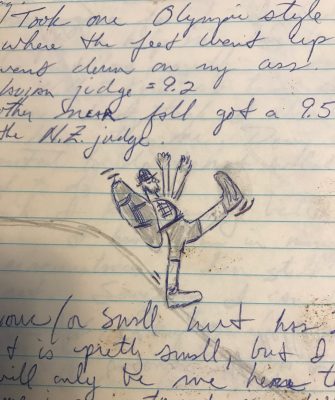
writing in my journal
From my New Zealand journal backpacking on Stewart Island on the muddiest trails I’ve ever seen

I love framing up blogs each month for people like you, and I also write a Christmas newsletter to family and friends now for over 30 years. Even my New Zealand book was completely based upon seven steno-pads of notes I took on my 8 months of traveling.

But why write?

Writing helps me remember things better. My strongest learning styles are partly kinesthetic and visual. I need to “see” the words in my head on paper and writing them down is so tactile. Even when I attend conferences, I tend to take tons of notes and seldom need to go back to them after. Just the process of note-taking helps me remember key points. But of course, I can go back to my notes and pick up the salient points from the session whenever I want.

Reflecting on the written words is much easier than reflecting on thoughts and ideas in my head. (See Fuzzy Thinking blog from a couple years ago). When I have an idea that I want to explore, writing it down forces me to get it organized in my head. What are the key points? What are the most important points? Why are they the most important? When that is all in my head, it is difficult to see the nuances. 

When it’s written, I can see how to best re-order the writing so it makes the most sense. Obviously, when trying to convey an idea or make an argument, it really matters what order you present them. Ultimately, I want you, the reader, to “get it” or to understand my thoughts better. As an extrovert, I can “throw words out” when talking, but often those words really need to be better organized. Writing forces me to take my extroverted words which are flying around the room, and corral them into some type of organized sense.

As I think about this (and write about it) I realize that I write for these reasons.

To Educate: My weekly career emails, my regular blogs, and my book are all examples of me taking an idea or a practice I know, and share it with others to help them improve.

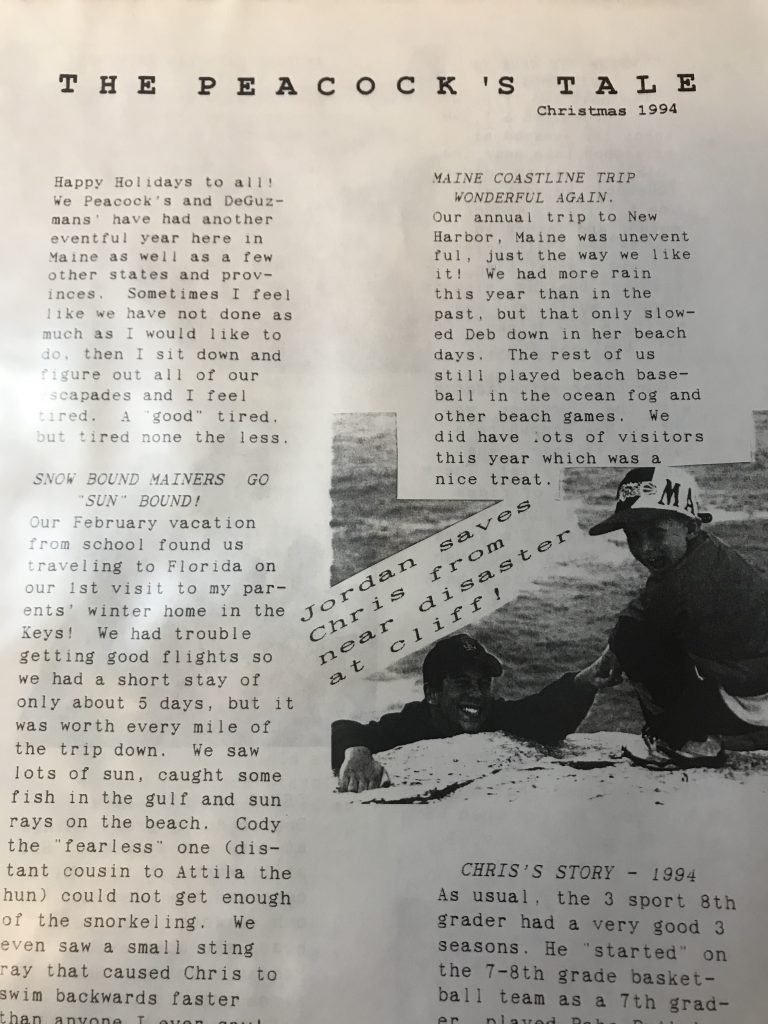
writing xmas newsletter

To Entertain: My Christmas newsletters are a recap of our year as a family, but I work very hard to make them entertaining as well. I’ve kept all of my newsletters over the years, and I know some of my family have kept some of them too.

My friend, Rees, was so disappointed when I converted from the typewriter with all the “whiteouts” (younger folks won’t even know what that is), typo’s, and mistakes, to the computer where I could “hide” all these changes.


Pictured here is my Christmas 1994 Peacock’s Tale with all it’s imperfections.


To Think: I like to journal each morning as a way to slow down and also to flesh out my thoughts on things.

For Legacy: My Christmas newsletters are a bit of legacy, and my New Zealand book about my travels was written for family and friends. Others can enjoy it, but it is a legacy book that I wanted to write for people who know me.

If you are a writer, I’d love to hear why you write.

If you are not writing regularly now, I encourage you to consider creating a routine and finding the time to write, then let me know what you think. (Write it down and send it to me 🙂


Jim Peacock is the Principal at Peak-Careers Consulting and writes a weekly email for career practitioners. Peak-Careers offers discussion-based online seminars for career practitioners focused on meeting continuing education needs for CCSP, GCDF and BCC certified professionals as well as workshops for career practitioners and individual career coaching.

He is the author of A Field Guide for Career Practitioners: Helping Your Clients Create Their Next Move and The Adventure of Finding Me in New Zealand. He is also the recipient of the 2020 Kenneth C. Hoyt Award from the National Career Development Association and the Mid-Atlantic Career Counseling Association’s Professional Contribution’s Award in 2020.

Sign up here to receive my  TOP 10 TIPS WHEN WORKING WITH AN UNDECIDED PERSON.  You will also receive the career practitioner’s weekly email on a variety of career topics, industry news, interesting events, and more. 
Filed Under: Career Tagged With: why I write

How to slow down

August 12, 2019 by Jim Peacock Leave a Comment

Are you walking too fast?
Want to know how to slow down?

How to slow down

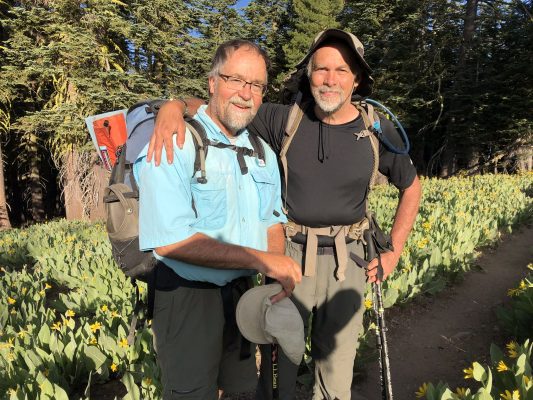
I just finished an 81-mile backpacking trip on the Pacific Crest Trail (PCT) in California with my two hiking buddies of 38 years. (Rees and Howard). We have been section-hiking the entire 2650 mile trail from Mexico to Canada since 1981 and Howard was completing the PCT on this 81-mile section…I had to be there with him.

There are many ways to hike the PCT. We choose to do sections ranging from 50 miles to 400 miles in length picking different sections from 1981 to present. Other people, called ‘through-hikers” attempt to do it in a single season, typically from April to October.

While walking about 11 miles per day and reflecting on many things, I considered the dichotomy of these two approaches to the same trail.  My hiking buddies Rees and Howard often talked about what the through-hikers were missing in their sprint to do the 2650 miles in ~5 months. My point has always been that there is more than one way of hiking this trail…just like there is more than one way of navigating your career development.

Section hiking allows us to hike at some of the best seasons for each section of trail. Rees and I hiked in the Mojave desert three years ago in April and were lucky enough to catch the desert bloom. The wildflowers were amazing!! We were able to hike this last 81-mile section in early August after a HUGE snowfall year that shut down the high Sierra’s in May and caused many through-hikers to wait or skip ahead because the snow was simply too deep.

— Stopping to enjoy the Mule Ear flowers in bloom–

Section hiking also allows us to manage our miles/day better. Most years we hiked about 12-15 miles per day. This year, our goal was 11 miles per day which was very comfortable. We often had our miles for the day completed by 1 pm which gave us a great siesta time in the heat of the day.

Meanwhile, the through-hikers we met along the trail (they were heading north and we were heading south) were all under pressure to hike 25-30 miles per day…some were actually hiking 40 miles per day!! While these hikers were getting up at dawn and walking until dark, we were stopping for breaks on the tops of mountains, taking 2-3 hour lunch breaks with naps, and setting up camp as early as 1 pm and no later than 5 pm every day.

One thing we do on the trail is to have discussions on things like “You are the average of the six people you hang out with. Who are your six people and what characteristics do they have you would like to emulate?” and “What are your goals for the next couple of years?” With 11 miles to walk each day, there is plenty of time to think and discuss many topics.

Not everyone can hike the PCT for 11 miles per day as we did…
so how do you slow down?

Just like in career development, there are many paths to success.

Is through-hiking the PCT in one season better or worse than section hiking? I believe there are times you must be goal-oriented and focused, like the through-hikers doing 25 miles per day (or more) totally focused on getting to Canada by October 1st when the weather turns nasty. And then there are times when we need to slow down and enjoy the moments of life presented to us each day.

For those of you who are “through-hikers” in your careers, “go for it” and push for your goals. But…(there is always a but isn’t there?) don’t forget that your brain and body need breaks from the intensity.

For those of you who are “section-hikers” in your careers, where the goals are not as intense as some, make sure you carve out the time each day to be “present” with yourself and the people you love.

How To Slow Down

  • Create a routine in your day that builds in quiet time to either read, write in a journal, or simply reflect.
  • Set a timer so that you never sit longer than 45 minutes. Then stand up, stretch, do Qi Gong, walk around, and maybe instead of texting or emailing someone, walk over and talk with them.
  • Practice mindfulness in your day. This can be a simple as eating your lunch or snack with no distractions. No checking your email, watching T.V., or listening to music. Just chew your food, one forkful or bite at a time. Don’t take the 2nd bite until you have thoroughly eaten the first bite. Focus on eating only. Clear your mind of everything else. Be mindful of the moment.
  • Take a short walk to get outside if you can. Being outdoors has scientific proof that it is good for us. (No music, no podcasts, just walk alone or with a friend).
  • Be “present” when you are with someone. This is a trait that my hiking buddy Howard is great at. When you are with Howard, he is totally with you and you can feel it.
  • Turn off your phone for a period of the day. Too often, we are “chasing” messages, phone calls, and emails. They can wait. Take control over your day.
  • If you can, take a “tech-free” retreat for a half-day or a full-day. I try to take a full-day “tech-free” retreat once per month. I write, read, meditate, and plan for the upcoming months. My brother chooses the months of the year that has five Friday’s in it, as there can be no ‘standing’ meetings scheduled on that day. He does his retreat about five times each year.

There are many ways to slow down in our lives, but all too often, we do not take advantage of it. My backpacking trips help reinforce the importance of slowing down. When I am off the trail, I often think back to our 11-15 mile days and how I feel when I can remove the clutter of our fast-paced world.

I’d love to hear what you can do to slow down in your day.
Please share your thoughts here.

Jim Peacock is the Principal at Peak-Careers Consulting and writes a monthly newsletter for career practitioners. Peak-Careers offers discussion-based online seminars for career practitioners focused on meeting continuing education needs for CCSP, GCDF and BCC certified professionals as well as workshops for career practitioners and individual career coaching. He is the author of A Field Guide for Career Practitioners: Helping Your Clients Create Their Next Move

Sign up here to receive my  TOP 10 TIPS WHEN WORKING WITH AN UNDECIDED PERSON.  You can also receive the career practitioners newsletter which includes a variety of career topics, industry news, interesting events, and more. 
Peak Careers - Professional Development for Careers

Filed Under: Career

My Career Inspiration for 2019

January 7, 2019 by Jim Peacock Leave a Comment

career inspiration

My career inspiration for 2019 starts by choosing three words to guide me throughout the year.

By choosing 3 words to guide and inspire me, rather than creating specific goals, I get career inspiration in a variety of ways, both personally and professionally.  When I think about “career” it is in its broadest definition as defined by Donald Super.

A career is defined as the combination and sequence of roles played by a person during the course of a lifetime. It concerns an individual’s progression through a series of jobs over his or her lifetime and includes that person’s education and unpaid work experiences, such as internships and volunteer opportunities.  Donald Super.

How I choose my words

I go on ‘tech-free’ retreats about once a month where I turn off my phone, stay off email, Facebook, LinkedIn, Twitter, Pinterest, and Instagram for the day. It is my day to write and think and read.

On my retreat in December, I spent time reading my daily journal for the entire year looking for themes, words, or ideas that keep appearing.

What I am looking for are words or ideas that can inspire me. Sometimes I find a repetition of negative words.  What I then explore is their opposite meaning to offer me career inspiration for the next year. I struggled this year choosing my third word and had to “call a friend”. (Perfectly fine way of doing it, as well as using a thesaurus).

I was trying to articulate a feeling I had but struggled to find a word that captured it. My friend Rees helped me describe my feeling with a word that felt right. I actually had four words this year and he also helped me narrow my list to the below three words.

By choosing a word, rather than one goal, I can utilize the meaning of that word to offer career inspiration throughout the year. Here are my words I used in the past three years.

2016 – Health ★ Mindfulness ★ Focus

2017 – Intentional ★ Authentic ★ Wellness

2018 – Reach ★ Capacity ★ Consistency

career inspiration

REFLECTION

This word came to me as I realized how beneficial it is to take time to slow down and think. Each day I start by doing some QiGong (like Tai Chi) to calm myself and then I journal. By writing with pen and paper it forces me to slow down and think through what is on my mind.

Each afternoon at 2:30, I take a meditation break. These routines give me time to pause the fast pace of life and in return, I find creativity and inspiration for my work and personal life.

PURPOSEFUL

One thing I noticed in my journal and also from my business coach, is that I tend to use words and phrases like, I will try and write this week. Or, I need to or should do something. What I will be saying (notice I didn’t say try to say) is I will be more purposeful with my intentions this year.

     i.e. I will finish my book for Career Coaches this winter.

     i.e. I will write my blogs at least one month ahead of time to allow my Advisory Board more time to review

GRATITUDE

I wanted a word that made me happy. I struggle with all the crazy news coming at me daily, sometimes hourly, and wanted a word like “laugh” or “joy” or “smile” but it just didn’t feel right. As I talked it out with Rees, I realized that the word ‘gratitude’ is all about the many things in my life that make me happy. It’s not just that I want to laugh or smile, but I want to look at all the positive things going on my life that keep me going.


Are you inspired to choose 3 words for 2019?
If so, please share them here or email me your words and why you choose them.

May 2019 be a rich and fulfilling year.

Read more on “reflection” here.

Jim Peacock is the Principal at Peak-Careers Consulting and writes a weekly career news email for career practitioners. Peak-Careers offers discussion-based online seminars for career practitioners focused on meeting continuing education needs for CCSP, GCDF and BCC certified professionals as well as workshops for career practitioners and individual career coaching. He is the author of A Field Guide for Career Practitioners: Helping Your Clients Create Their Next Move

Sign up here to receive my  TOP 10 TIPS WHEN WORKING WITH AN UNDECIDED PERSON.  You can also receive the career practitioners newsletter which includes a variety of career topics, industry news, interesting events, and more.
Peak Careers - Professional Development for Careers

Filed Under: Career Tagged With: 3 Words, 3 words to guide me, career inspiration, gratitude, purposeful, reflection

  • « Go to Previous Page
  • Page 1
  • Page 2
  • Page 3
  • Page 4
  • Go to Next Page »

Footer

Connect With Peak Careers

  • Facebook
  • Instagram
  • LinkedIn

NCDA-approved provider

Career Practitioners Subscribe Today

Sign up for "the Top 10 Tips When Working With an Undecided Person" and also receive a weekly email on a variety of career topics, industry news, interesting events, and more SUBSCRIBE

Copyright © 2025 Peak Careers

Subscribe

Sign up here to receive my  “TOP 10 TIPS WHEN WORKING WITH AN UNDECIDED PERSON”. 

You can also receive our weekly career practitioners email which includes a variety of career topics, industry news, interesting events, and more. 

Subscribe Today